See what’s happening
behind the surface.
Targeted, minimally intrusive investigations of cavity walls and concealed building areas where further evidence is needed to understand a damp or construction-related problem.
DF Damp Consultancy provides independent borescope inspections with no remedial works, damp-proofing systems or treatments to sell. The purpose is to gather evidence - not create work.
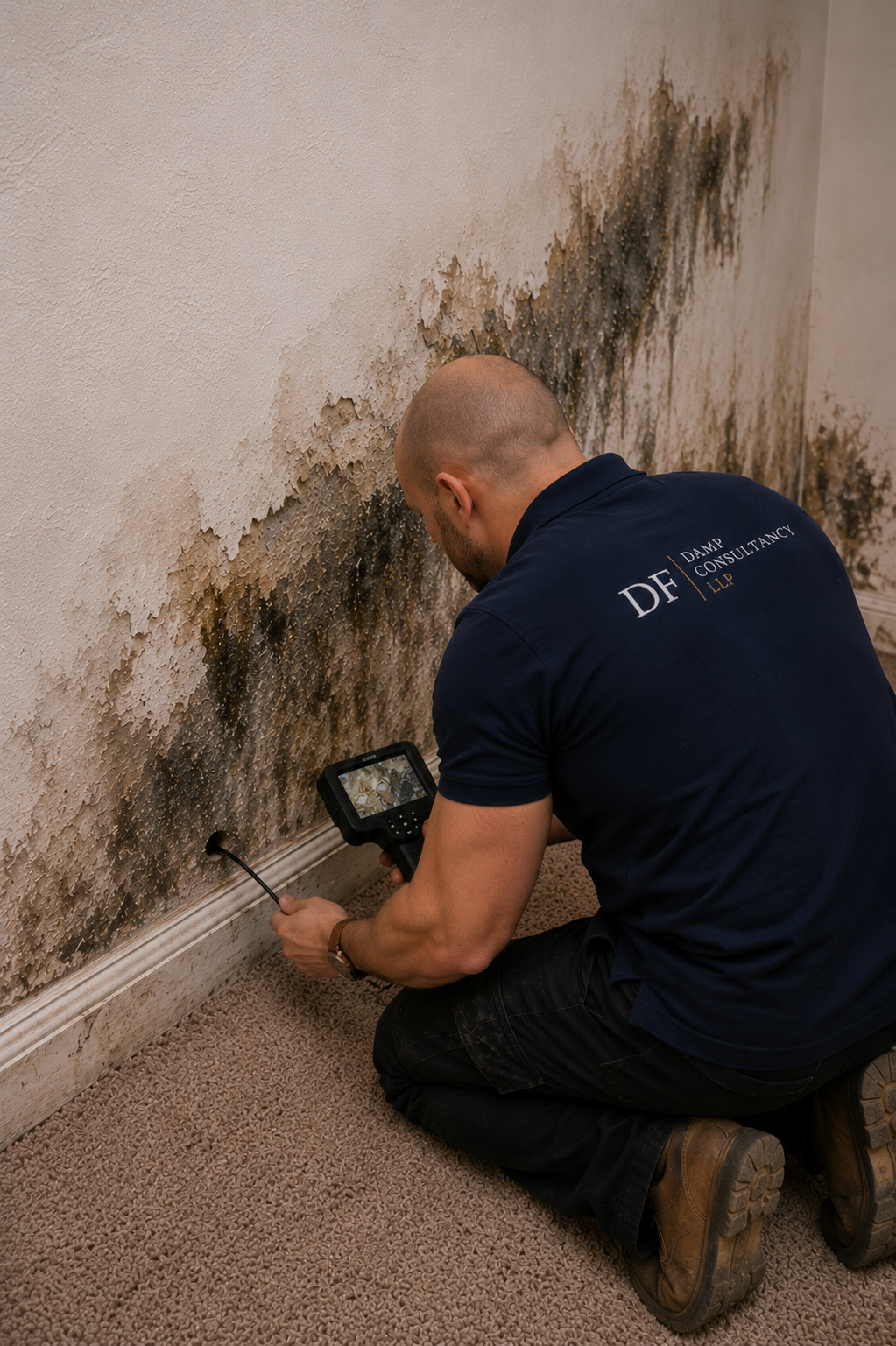
Sometimes the cause
cannot be seen.
A non-intrusive damp survey can identify patterns and likely causes, but some defects remain concealed within the building fabric.
A borescope allows targeted visual inspection of accessible cavities and concealed spaces through small, carefully selected access points. This can provide additional evidence where the condition of the cavity, insulation or hidden construction details may be contributing to moisture-related problems.
A borescope inspection is therefore used as a further investigative tool rather than as a substitute for understanding the building as a whole.
Hidden conditions.
Better evidence.
The inspection is targeted around the suspected defect and the information gathered during the initial damp investigation.
Cavity Debris
Debris, mortar droppings and other materials capable of bridging a cavity and creating a potential moisture pathway.
Insulation
The visible condition, distribution and presence of insulation within accessible areas of the cavity.
Moisture Bridging
Evidence of materials or construction details capable of transferring moisture between external and internal wall leaves.
DPC & Wall Details
Visible construction details at accessible inspection points, including the approximate DPC zone where identifiable.
Concealed Voids
Accessible floor, wall or other voids where their condition cannot otherwise be assessed without more disruptive opening-up.
Construction Defects
Localised workmanship or building-detail issues that may be relevant to moisture movement or dampness.
We investigate the cavity.
We don’t sell the repair.
Our opinion is not influenced by the need to sell cavity clearance, damp-proofing treatment or remedial building work.
The purpose of the inspection is to determine what can actually be observed within the accessible concealed area and whether those findings help explain the dampness or defect being investigated.
If remedial work is considered necessary, the recommendation is made because the available evidence supports it — not because DF Damp Consultancy will profit from carrying out the work.
Targeted investigation.
Minimal disruption.
Initial assessment
The areas of concern are first assessed so that the borescope inspection can be targeted at locations most likely to provide useful evidence.
Access points selected
Small access holes are positioned at agreed locations. Where practicable, these are placed through mortar joints or other suitable areas to minimise unnecessary disturbance.
Borescope inspection
Specialist camera equipment is inserted into the accessible cavity or void to inspect the concealed construction and record relevant findings.
Findings reviewed
The borescope evidence is interpreted alongside the wider building condition and moisture findings rather than being considered in isolation.
Report and recommendations
Where a written report is included, the findings are documented with relevant images, professional opinion and proportionate recommendations for any further investigation or remedial work.
The equipment matters.
Interpretation matters more.
A camera image is only useful when it is interpreted in the context of the building, its construction and the moisture-related evidence identified elsewhere.
BSc (Hons)
Building Surveying
First Class Honours degree providing professional knowledge of building construction, defects and building pathology.
MCIOB
Chartered Member of the Chartered Institute of Building, demonstrating recognised professional competence and experience.
CSTDB
Certificated Surveyor of Timber & Dampness in Buildings, providing specialist knowledge of dampness, timber decay and wood-destroying insects.
Further investigation
where evidence is concealed.
Dampness is present but the likely moisture pathway cannot be confirmed from visual and non-intrusive inspection alone.
Cavity wall insulation, debris or bridging is suspected.
Previous alteration or repair work has created uncertainty about the concealed construction.
More evidence is required before recommending larger-scale opening-up or remedial work.
Evidence you can see.
Relevant images captured during the inspection can be incorporated into the written findings so that concealed conditions can be clearly explained.
From camera image
to professional opinion.
Where reporting is included, we explain what was visible, what the evidence may indicate, the limitations of the inspection and what further action is considered proportionate.
A borescope only provides a view of the accessible area immediately surrounding the inspection point. Findings are therefore interpreted carefully and are not assumed to represent every part of the cavity or concealed construction.
Tell us what’s happening.
We’ll advise what to inspect.
Send us the property postcode, the area of concern and any relevant photographs. We can advise whether a borescope inspection is appropriate and provide a tailored quotation.
Do we cover
your postcode?
Enter your town or postcode to check whether DF Damp Consultancy regularly surveys properties in your area.
View full coverage area →